Highly profitable Stayz.com.au finally reveals financials

Stayz.com.au has revealed its financials for the first time. Australia’s most popular holiday house site made a profit of A$13 million before interest, tax, depreciation and amortisation on revenue of  A$23.1 million in the 2012 financial year.

This makes it Australia’s #2 accommodation booking site behind Wotif.com and gives Stayz a whopping gross margin of 56.3%, which will be tough to sustain in an increasingly competitive market.

Stayz GM Anton Stanish told investors at a Fairfax Media briefing that the compound annual growth rate for the company, which had revenues of just A$6 million in 2008,  from from 2010 to 2012 was 30%.

But this has now slowed. He said revenue growth for the first half of the 2013 financial year “in a challenging market (was) above market trend in the low to  mid teens”.

Mt Stanish said Stayz commissions remain low by industry standards at between 8% and 9%.

“We’re completely comfortable with that because we think that gives us options for the future,” he said.

The Stayz group – which also includes Rent-a-home.com.au and Takeabreak.com.au – has 48,000 listings, 1.4 million newsletter subscribers, 2.5 milion website visits and generates 4.5 million queries a year. It is owned by Fairfax Media.

Global marketing refresh for HotelsCombined

Meet Max, the somewhat cynical, not so cuddly bear that meta-search company HotelsCombined has chosen to unify its site branding and also help consumers through the booking process.

Max now appears on all HotelsCombined owned properties, including several newish market-specific sites – DetectaHotel.com (Latin America), Biyi.cn (China) and RoomGuru.com (Russia).

It’s another step in the evolution of HotelsCombined, which is now in scores of markets. Growth has been extremely strong in recent times, though some markets remain challenging.

In its home market of Australia, HotelsCombined doubled its hotel bookings year on year to 300,000 transactions in 2014 with further strong growth anticipated this year.

As the company has grown, its marketing – once focussed on SEM and affiliate – has evolved and expanded into new areas such as television.

It now has TV campaigns running through Jan/Feb in a slew of markets including Korea, Middle East, Russia, Hong Kong, Taiwan, Australia, Ireland and France.

Head of Communications Alex Wenger explains: “We needed a global symbol and picked a teddy bear because it’s a trusted endearing symbol that generates a connection with the audience.

“It also symbolises a good night’s sleep.”

But Max is also a bit cynical and definitely not cuddly, says Chief Operating Officer Hichame Assi. As with everything at HotelsCombined, Max is there to increase booking and conversions. At the moment, Max is part of a new logo, appears on the websites and apps but will soon be introduced to the television campaigns.

“There’s no finality to this and we’ll be refining as we go along,” says Hichame. Like with everything else.

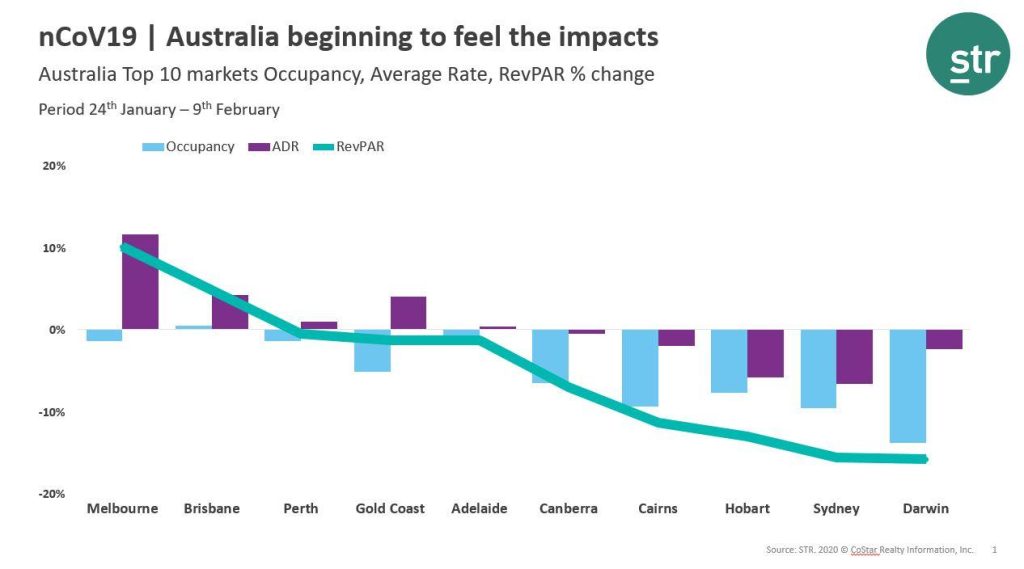
Coronavirus hits Australian hotel performance

Australian hotels have been severely impacted by the coronavirus pandemic and related bans on Chinese travellers.

STR data shows Melbourne and Brisbane were the only two major Australian markets to report  year on year RevPAR growth between 24 Jan and 9 Feb, 2020, a two week stretch encompassing Chinese New Year.

All other markets were hit hard with occupancy falling faster than rates.

“Performance was largely unaffected through to the 30th of January. However, as the travel restrictions were enforced the impact has been more noticeable.”

Analyst Matthew Burke said: “Those destinations that see a higher proportion of Chinese visitation appear to be the most impacted.”

He said STR is now working with partners to determine what the impact will be on the meetings industry and international more broadly.

Changes ahead for GDS business model

President and CEO of Abacus, Robert Bailey, admits that the rise and rise of low cost carriers will inevitably lead to changes in the 40-year-old business model of Global Distribution Systems. “Low cost carriers will be a catalyst for change,”  Mr Bailey said.

“What the change will be I don’t know.” Mr Bailey said low cost carriers now comprise 25% to 26% of the available air seat capacity in Asia Pacific “and this can only grow” with the opening up of new regional markets and city pairs.

But many low cost carriers don’t want to do business with the GDS such as Abacus, Amadeus, Sabre which derive most of their revenue from charging traditional or legacy carriers around US$6 to US$8 per sector to distribute their airfares to travel agents.

This is a major issue for the GDS because 1. their main customers, legacy carriers, are in apparent decline and 2. The fastest growing sector of the aviation market, low cost carriers, in many cases does not want to pay their rates.

Some compromises have been reached with low cost carriers moving up the aviation food chain but fundamental differences remain.

And it’s not just all about cost. There are also technical and commission issues with the sale of ancillary products such as food, entertainment, even blankets – which is where many low cost carriers make most of their money – through intermediaries.

This attitude is not likely to change any time soon, even among carriers such as Scoot which are using the GDS to distribute.

Steven Greenway, Scoot’s Head of Commercial, recently told delegates at TRAVELtech that: “Everyone still gets commission and I think that is pathetic”.

Anyway… Despite the challenges ahead, Mr Bailey believes low cost carriers are ultimately a good thing for the travel industry, including the GDS.

“Low cost carriers are going to grow the pie, introducing new travellers to the mix” who will over time become more adventurous and wealthy and begin flying hybrid and full service carriers, My Bailey said.

Mr Bailey remains upbeat about the prospects of legacy carriers in the long haul arena despite some poor recent results from regional giants Singapore Airlines, Cathay Pacific and Qantas.

“I think we are going to see some quite significant growth of traditional carriers,” he said. However, it’s a tough environment distorted by the presence of government-owned regional carriers without the same financial controls.

“Where you have state-owned carrier competition you will never have a level playing field,” he said.

Mr Bailey was speaking after addressing the Abacus International Conference in Seoul recently, during which he also made the following points:

  • By 2025, 32% of the world’s air traffic is expected to originate in Asia Pacific (AP).
  • Low cost carriers now comprise 25% to 26% of the available air seat capacity in Asia Pacific “and this can only grow”
  • Annual tourism growth in Asia Pacific over the next few years is forecast to at between 6% and 8%.
  • “Things are going off the boil a little but is still bit fundamentally sound”.
  • Corporate trips were up 6% in the first half of 2012 but the AP business market is a unique beast – “fragmented, not as well developed and advanced as many western countries”.
  • Business travel represents 26% of the total AP travel market and presents a “massive opportunity.”
  • “There is going to be consolidation and regionalisation of corporate travel businesses.”
  • Indian outbound – 12.5m in 2010 – will quadruple to 50m by 2020.
  • South Korea is “probably the world’s most wired country” with huge uptake and the most readily available high-speed broadband on the planet.
  • Yet he says South Korea’s population have been slow on the uptake when it comes to researching and booking travel, lagging other less tech-savvy nations.
  • 61% of Indonesia’s internet usage comes through mobile.
  • The new traveller experience is “all about me!”

Brendan Murphy believes Australia’s international borders will stay closed for 2021

Australia’s highest profile medical professional, Dr Brendan Murphy, pictured, says he doubts that Australia’s international borders will reopen this year.

Dr Murphy acknowledged ABC News Breakfast yesterday it was a “big question” and that “I think that the answer is probably no.

“I think that we’ll go most of this year with still substantial border restrictions, even if we have a lot of the population vaccinated. We don’t know whether that will prevent transmission of the virus.”

He also cautioned that the volatility of the Covid pandemic mages forecasting difficult, telling interviewers that the rule book has been made up as we go”.

“I don’t want to predict more than two or three months ahead,” he said.

“The world is changing. I think at the moment, we’ve got this light at the end of the tunnel – the vaccine – so we’re going to go as safely and as fast as we can to get our population vaccinated and then we’ll look at what happens.”

Resort Reviews – Treble Cone and The Remarkables

This is a tale of two South Island NZ ski resorts: Treble Cone and The Remarkables.

They are very different but each does their job well with a recent trip confirming that neither actually conforms to their popular stereotype.

For example, Treble Cone has a rep that it’s an experts-only mountain, while The Remarkables is known as a place that only beginners should visit.

Neither is true. I skied both resorts last week and here are my thoughts.

The Remarkables, a 30-40 minute drive from Queenstown, is tucked in a big bowl behind the spectacular clutch of mountains (‘The Remarkables’) that frame Queenstown.

It has a 1586 metre base and generally much better snow that its local resort rival, Coronet Peak.

The road up is an NZ classic – long, curvy and precarious in parts with amazing views providing a dangerous distraction.

On arrival you park below the resort and catch the shuttle to the base building.

There are several car parks and on a busy day you may have to park many kilometres down the road.

Fortunately that wasn’t the case when we were there with well less than 1000 skiers, most of them beginner to intermediate.

It’s true that The Remarkables is a great place to learn to ski or board, with several lifts serving wide open beginner runs.

But there are also some excellent off-piste opportunities to keep experienced skiers and boarders happy.

Most of these are accessed from the Shadow Basin. Some you can traverse to, others require a hike.

On the food front, The Remarkables offers the kind of stuff you’d find at a football stadium in a smart new base building.

To sum up, The Remarkables catches lot of sun, has good quality snow, excellent views and is an ideal mountain for groups of mixed ability.

However, staff need to work harder on food and beverage.

PS: One gripe, the only visible clock on the mountain is set to the wrong time – can someone fix it already…

Treble Cone, located 29km from Wanaka, has just two chair lifts.

But it’s the terrain, snow and views these lifts access that matters.

You suspect that’s why it was voted New Zealand’s best ski resort in 2013 and 2014 in the World Ski Awards.

Like The Remarkables, Treble Cone is accessed via a dirt road that can get edgy at times, especially when there’s been rain or snow melt – icy ruts ain’t fun. But the resort is.

TC, perched high above Lake Wanaka, has some of the best views of any resort in the world.

And the snow is good too with TC getting more from the north storms that any other resort in the region.

Its base is 1260m while the Summit, which you can hike to, is 2088m.

Lifted vertical is 700m while the resort claims 550 hectares of skiable terrain – the most on the South Island – 10% beginner, 45% intermediate, 45% expert.

Skiing with my fast-learning 14yo son, I found TC to be an excellent mountain for all abilities; for someone who wants to progress, TC is ideal.

Sure there are natural half-pipes, chutes, cliffs, jumps etc but there’s also heaps of great intermediate skiing, which the resort is increasing each year.

Lunch is also good (less of an emphasis on fried food than other resorts) though the restaurant can get over-crowded.

Service at the resort is friendly, professional and pro-active. For example, I was putting on my jacket and knocked over a bottle of Coke.

A staff member saw this, picked up the bottle, said “it happens” and brought me a new one. Impressive.

In summary, Treble Cone is a special mountain and everyone who loves the snow should make the effort to get there.

And it would be even better, if they had another lift or two to access more of that wonderful, wish I could get there terrain…

Rachel Argaman, CEO, Toga Hotels

A visionary leader who believes in “encouraging the heart,” Rachel is currently the CEO of Toga Hotels.

With over 20 years international experience at senior management level in the travel and hospitality industry, Rachel has a passion for creating a results-oriented, responsive and market-driven culture within companies.

This is backed by a driving belief that the success of businesses depends on the quality of the people they employ.

Rachel has a proven track record of increasing sales, global market share and profitability. She is focused on the accelerated growth of the Toga Hospitality Group, and the brands: Travelodge Hotels, Adina Apartment Hotels, Medina Serviced Apartments and Vibe Hotels.

Her experience includes managing company growth, takeover and integration, the establishment of new brands, and ensuring the success of Toga
Hospitality’s incubator business in Europe.

Rachel’s success to date has been recognized by various industry and business awards. At the 2010 Awards for Hotel and Accommodation Excellence, Rachel was named HM Magazine’s Hotelier of the Year.

In December 2008, Rachel was named the Telstra National Corporate Businesswoman of the Year.

October 2010 saw Rachel participate in the Australian version of Undercover Boss, allowing her to see her company through a “different lens” as she worked on the front line of the business, a move which facilitated ongoing changes for the way Toga’s senior management team supports the business.

Rachel holds an MBA in Service Industry Management and is passionate about the travel industry.

Born in England and raised in South Africa, Rachel (together with her husband and three children) now calls Australia home.

Booking.com launches new cleanliness standards for short term rentals

Booking.com has decreed that short term or holiday rentals will have to meet a minimum cleanliness standard by May 4, 2021, or have their properties delisted from the world’s biggest online travel agent.

“We’re asking partners to commit to a Minimal Cleanliness Score of 6 out of 10,” Booking.com has advised properties.

“A property that’s doesn’t meet these cleanliness standards will be notified and put on a warning list.

“During the six-month probation period, we’ll be monitoring guest feedback for clear proof of cleanliness improvements.

“Once your new cleanliness score reaches an average of 6, we’ll remove your property from the warning list. If it doesn’t improve to at least 6, we’ll remove your property from our platform.”

Booking.com has been trialling the new standards in partnership with Properly and says the new benchmark is an average of the cleanliness review scores received from all guests.

See: Details of Booking.com’s new cleanliness guidelines.

Will Deague, CEO Art Series Hotel Group

William Hunter Deague is the Chief Executive Officer of Asian Pacific Group (APG), the parent company of Australia’s hottest hotel group – Art Series Hotel Group.

Educated at Melbourne Grammar, Will holds a Domestic Builders Licence (unlimited) and a private fixed wing and helicopter licence. Joining APBC in 1996, Will worked on a range of projects before being appointed as CEO in 2008.

His first major project as CEO was to organise and oversee the refurbishment of the former PANCH hospital in Preston into what is now known as Bell City, a very successful project for the company.

In 2001 the Deague’s sponsored a project to create excitement around landscape painting in Australia titled William Creek and Beyond.

Will and ten of Australia’s greatest artists including John Olsen went on an exploration to central Australia to create a series of artworks that received critical acclaim. It was on this trip, that the idea for the Art Series Hotels was born.

In 2009 Will made this vision a reality taking charge of the $500 million Art Series Hotel Group project. In October 2009, The Cullen opened on Commercial Road, Prahran and has already received two international accolades including a listing on the Conde Nast Traveler Hot List for 2010 and a nomination for Australasia’s Leading New Hotel at the 2010 World Travel Awards.

The Olsen Hotel opened in March 2010, the flagship of the group including 14 floors, glass-bottomed swimming pool, two restaurants and day spa. Rounding out the group, The Blackman opened in Melbourne in August 2010.

A commitment to implementing eco-conscious initiatives within the Art Series Group has seen Will purchase eco-friendly SMART cars and bicycles for guests to hire.

Energy efficient globes and equipment replacements, building control upgrades, drought-resistant gardens and rainwater tanks at selected sites are all a part of the group’s efforts to be conscious of the environment.

Over the next twelve months the main focus will be on project design and optimisation in sourcing energy-efficient solutions.

Aged 34, Will is currently the president of the St Kilda Road Precinct Committee, a role that requires him to chair meetings and lobby sponsorships and funding for future projects.

To build on his already diverse skill set for his varied roles, Will has recently completed the OPM Course at Harvard for CEO’s.

Will Deague is the eldest of four siblings Anthony, Jonathan and Camilla Deague. In February 2007 Will married Natalie Brownlee and they have two children Hugo and Sibella Deague.

Will enjoys membership to the following clubs; South Yarra Lawn Tennis Club, Victoria Racing Club, Melbourne Cricket Club, The National Golf Club, and the Sorrento Golf Club.

Sue Badyari, Chief Executive Officer, World Expeditions

Sue Badyari, is CEO of the World Expeditions Travel Group, operator of small group adventure tours all over the world. 

World Expeditions is Australia’s longest established adventure travel company and offers more than 500 stand-alone itineraries, escorted by expert leaders and meticulously designed for those travellers who want to take the ‘paths less travelled’.  

Under her leadership, the group has grown from a single brand company when she took up the helm in 1999 to a multi brand operator and distributor of travel products. She has been the driving force behind its many achievements, including:

  • Establishing Australia’s first Charity Challenge with the Fred Hollows Foundation
  • Acquiring Tasmanian Expeditions and the UK based Sherpa Expeditions and establishing the UTracks self-guided travel division
  • Conducting the negotiations and due diligence for purchasing Adventure South New Zealand (2010); Trail Journeys (2017) and the Blue Mountains Adventure Travel Company (2018)
  • Developing the World Expeditions’ domestic brand, Australian Walking Holidays and creating the award winning semi-permanent campsites on the Larapinta Trail
  • Becoming the first-ever commercial operator of the full Nepal 1700km traverse of the Great Himalaya Trail ( recognised worldwide as an outstanding operational achievement) and over-seeing the establishment a network of permanent campsites in the Everest and Annapurna regions
  • Developing the World Expeditions Community Project Travel program and establishing the World Expeditions Foundation, which became a pivotal fundraising portal in the wake of the devastating Nepal earthquakes in 2015.

In recognition of her pioneering work in adventure travel, Sue is a regular speaker at international tourism and travel events, including the IIPT World Symposium (Johannesburg, South Africa), NZ Adventure Travel Trade Association event (Auckland, NZ), Global Eco Tourism Conference Asia/Pacific (Sydney, Australia). 

Travel media regularly seek comment from Sue about issues pertaining to the adventure travel industry.

Sue travels extensively and believes that the most authentic travel experiences occur when travellers get off the beaten track. Her main priority is to develop tourism that goes hand in hand with the local community and protects the natural environment.

Responsible and sustainable travel is core to her philosophy and deeply imbedded in all aspects of the World Expeditions Travel Group’s activities.

Under Sue’s leadership, World Expeditions offers a flexible work environment to enable parents with children to continue to work and to progress with their careers.

Evidence of the long term retention, progression and satisfaction at World Expeditions can be seen by the proportion of employees who have reached 10+ years of service to the organisation.

AFTA left hanging after Prime Minister promises

Australian Federation of Travel Agents CEO Darren Rudd appears to have awkwardly misjudged the political climate by prematurely announcing a funding package that has yet to eventuate following a conversation with Prime Minister Scott Morrison.

Rudd, pictured, who had asked the Federal Government for $250 million emergency funding over 18 months for travel agents, wholesalers and tour operators, told delegates at the Travel Daze conference Morrison  assured him in a video call that he’d get personally involved to push the funding through.

“There’s been a range of discussions with Treasury and with [the Department of] Finance since the Budget, working through a range of scenarios, configurations, and feeding a whole lot of data,” Rudd told delegates last Monday, 2 November, according to event coverage from Travel Weekly.

“I am hoping that we get indication if not [Tuesday] evening, then by Wednesday, of what the package looks like.

“If it wasn’t going to get fixed by (last) Wednesday, (the Prime Minister) was going to get more involved himself.

“The Prime Minister is acutely aware, the Cabinet are acutely aware, different politicians of all colours and persuasions are acutely aware of the need for this sector to survive and be funded to that end.”

Rudd added: “And he put a footnote if it wasn’t sorted this week, then hopefully we’ll get an understanding of what it looks like.”

AFTA has said nothing about funding since nor has the Federal Government.

There was no mention of the announcement in AFTA’s weekly Travel Daily column yesterday.

Instead it was business as usual with AFTA advising members not to expect an update any earlier than November 25.  

“AFTA CEO Darren Rudd is in Canberra again this week, for the fourth week in a row, to further progress discussions with Federal Government supporting agencies with a travel sector rescue package,” read the lead paragraph.

“Darren has also had ongoing discussions with (opposition leader) The Hon. Bill Shorten and will be meeting with a range of politically diverse parliamentarians when in Canberra.

“As a placeholder, we have tentatively scheduled our monthly webinar for 11am on Wed 25 Nov to provide members with a detailed update.”

So what happened – did Rudd, an experienced lobbyist, completely misunderstand what he was being told by the PM or is the government taking petty revenge for jumping the gun with his announcement? Who knows.

The bottom line is that travel still has no proper funding from any level of government despite their actions being the cause of so much industry misery.

Border openings drive car hire bounce back at Hertz

After a tough year in which demand slumped through COVID by up to 90 per cent, Hertz Asia Pacific boss Eoin MacNeill says demand is bouncing back with the car hire giant starting to rebuild its fleet after cutting it by almost 40 per cent during the height of the pandemic.

MacNeill says corporate has held up better than initially expected, underpinned by strong mining sector demand in WA and central Queensland, while government and insurance replacement business has also remained constant.

Leisure was hit particularly hard through the year but is making a comeback closely linked to border re-openings.

“We even saw an uplift when NSW opened to South Australia. People were going there for leisure as a destination because it was where they could go as opposed to Victoria or Queensland,” says MacNeill.

“So that does show that people have pent up demand and they will travel. As each of the borders come down we are starting to rebuild our revenue base. We did have in our forecasts for this quarter a Trans-Tasman bubble but that hasn’t happened and there’s further upside when that happens.

“But domestic tourism is quite strong and we are getting a lot interest for Christmas now with those borders (Queensland and Victoria) coming down and I think that’s really going to accelerate as people have the confidence that there’s no more infections and no more closures.

“I think that certainty is really important in terms of that pent up demand and getting out there and seeing our country.”

He believes corporate will lift through the first quarter of 2021, although inbound international, which typically comprises 15 per cent of Hertz business in Australia, will be off the table until at least Q4.

Booking fees, questions, lawyers and Webjet

Flight booking fees – now eliminated at Zuji and Expedia – appear to be a sensitive topic at Webjet, which charges up to $49.90 in fees to process international airline bookings ($29.95 processing fee, $19.95 price guarantee), and $29.90 for domestic airfares ($19.95 processing fee, $9.95 price guarantee).

Lawyer Paul Zawa from Minter Ellison got in touch with TravelTrends.biz on behalf of Webjet with a six-page Letter of Demand in relation to coverage on this site and elsewhere. Long story short, I responded with a series of questions which Webjet refused to answer. Several concerned Webjet’s “Price Guarantee” which it appears to have introduced for airline bookings in 2005.

The “Price Guarantee” was initially $1 per sector but has since risen to a flat $9.95 – an increase of 995% in four or five years – and now applies to “any hotel, car rental or insurance product booked at the same time” as an airfare. In 2005, Webjet also charged a $6.95 “service fee” for flight bookings. This “processing fee” now costs at least $19.95 – an increase of almost 300% . Questions included:

What is the justification for charging significantly higher fees on international flights as opposed to domestic flights?
 Please clarify that international airlines pay Online Travel Agents a commission for selling their product while domestic carriers do not.
 (CEO) David Clarke recently told Travel Today that Webjet’s booking fees will rise not fall. Please elaborate.
 What percentage of Webjet’s turnover is generated by booking fees?
 How much money was generated last financial year by the seat price guarantee?

Webjet lawyer Paul Zawa responded: “We are not the spokespersons for our clients. However, we have forwarded your questions to Webjet. We are instructed that Webjet does not intend to respond.”

Karthik Siva, Chairman, Global Brand Forum

Karthik is the founding Chairman of the Global Brand Forum, Asia’s most influential Forum for brands, business and leadership described by BBC as the “ Davos of Branding “. Karthik has been responsible for bringing some of the world’s most influential leaders like Al Gore, Francis Ford Coppola, Rudy Giuliani, Dame Anita Roddick, Warren Bennis, Prof Emeritus David Aaker, Spike Lee, Oliver Stone, Jimmy Wales amongst several other global leaders and icons to Asia.

Karthik is one of the most respected and influential brand strategy experts in Asia and is often called to advice Governments and Ministries to position and develop brand strategies for cities and countries. He has advised the Economic Development Board of Singapore, Economic Planning Unit of Malaysia, Ministry of Information, Communication & The Arts Singapore, Ministry of Manpower, Singapore, Securities Commission Malaysia, Prime Ministers Dept of Malaysia etc.

Karthik has also advised and consulted with several global, regional and local brands in strategy development in the FMCG, Banking, Technology, Telecommunication, Airlines & Hospitality industries across Singapore, Malaysia, India, Indonesia, UK, and the United States. He has also been responsible for the development of a White Paper to develop the creative Industries in Singapore and a Brand Positioning Strategy to make Singapore a Global Cosmopolis. Karthik was also responsible for helping develop and execute the world’s first in depth study and segmentation of “Billionaire Mindsets”.

After obtaining his Masters in Business Administration ( MBA) in Organisational Development and Marketing and Bachelors’ in Commerce ( BCOM ), Karthik has spent over 20 years in strategy development, marketing, advertising, brand planning & brand consulting at Xerox, Bateys, Leo Burnett, The Lab and Ogilvy. In the last 10 years, he has held senior leadership positions and has become one of the most sought after branding experts in Asia.

Karthik is a much sought after speaker, trainer and facilitator in Global and Regional forums and conferences on brand development, leadership development, employee alignment, motivational themes, corporate reputation and strategy development. Karthik’s unique skill lies in his capacity to meld motivation, leadership, spirituality, philosophy, psychology and healing skills in all his workshops and training programmes.

Besides being the only brand expert to speak at the APEC summit, he has also been profiled in CNBC, CNN, BBC, Business Times, Economic Times, Business Today, Channel News Asia, Philippine Daily Enquirer, The Edge Magazine, Straits Times, TV3, etc He was also voted as one of the top newsmakers of the year by Ad Asia in 2007 / 2008 / 2009 .

Taking the road less travelled – who knew it could be so much fun?

As scenic drives go, the 836km between Sydney and Melbourne along the Hume Highway is, for many people, exciting as a TV test pattern.

The sprawling country between Australia’s two largest cities is always dry and the weather hot, with a midday glare that somehow lasts for hours. Sheep, cattle, hills, grass, dirt, rocks, drought. Roadside toilets and rubbish bins. 

It’s a drive my family has been doing regularly for 20 years with the primary goal of completing the trip in less than 10 hours without a speeding fine and family unity intact. 

In the past we often used to stop in Holbrook, which bizarrely features a 90 metre long submarine, HMAS Otway, plonked in a local park, that kids of all ages love clambering over.

However, apart from that it was always pedal to the metal and a wary eye for the police.  

But this year, with kids grown up and some time on our hands, my wife and I decided to take the road less travelled and spend a couple of nights enjoying regional Australia.

Niagra Cafe, Gundagai

Leaving from Sydney at midday on Wednesday, the plan was to stay on the Hume until just after Gundagai  about four hours drive south, before taking a left for a hopefully scenic drive through the foothills of the Snowy Mountains, stopping in the small town of Tumbarumba that night.

The decision was immediately vindicated. Leaving the roar of the freeway behind, the road rocked and rolled through some beautiful hilly countryside.  There was plenty of water in the creeks, which flowed freely and healthily, bringing joyful movement to a classic rural still life.

We passed through the village of Adelong – old, well-maintained, alluring – and headed higher along the road to the apple growing mecca of Batlow at 775 metres.

Recent bushfire scars were evident on near and far horizons – blackened trees and scorched earth dramatically speaking of a time when it seemed the entire east coast of Australia was alight, shrouded in smoke, flame and death.

Some trees are rebounding faster than you’d think possible, but many others – probably the majority – are gone for good.

All the dead trees near the road have been felled for driver safety and huge piles of blackened logs lie silent.

Most of the orchards seem to have been spared though and the trees were vibrant with growth.

Apple orchard near Batlow.

We’d chosen Tumbarumba because a rail trail had recently opened there and we’d heard it was good fun. Rail trails are redundant rail lines that have been converted into bike tracks.

Batlow wants a rail trail.

There’s numerous rail trails in Victoria, where they’re very popular, but only a few in NSW, a situation many local groups are trying to change for the simple reason they attract visitors and bring tourism dollars to sleepy rural economies.

That’s certainly what’s happened at Tumbarumba.

Since it opened in April, more than 10,000 riders have experienced the 21km rail trail, which we rode the following day after hiring two e-bikes ($49 half day) from Tumba Bikes and Blooms.

Back in the day steam trains used to operate on the line between Tumba and Wagga.

It was great fun, especially on an e-bike, which makes the hills a breeze, and is a really good way to connect with the Australian countryside.

There were only three or four other people the day we did it – a mixed bunch – but the trail gets busier on the weekends.

After a quick swim in the local pool (free) and a visit to the chemist for some hay fever medication (first time ever, all that fresh air) we hit the road to Beechworth, about two or three hours south-west on the edge of the Victorian high country.

On the map it doesn’t look that far but mountains get in the way and so there’s no logical route. This became clear after stopping in the local store at Jingellic for directions.

No-one could name the fastest (and most scenic) route with any certainty. Just cross the bridge and follow the river, which we did and were richly with a beautiful journey beside the upper Murray River all the way to west to Wodonga  before a short straight south to Beechworth.

Upper Murray River downstream from Jingellic

TFE Hotels left with Travelodge COVID quarantine mess, guests evacuated

The reputation of TFE Hotels, one of Australia’s largest accommodation groups, has taken a hit after 366 guests quarantined in the Travelodge Hotel Sydney were last night evacuated by NSW Police who determined that complaints about poor standards of cleanliness and hygiene at the property were valid.

Guests, some of whom had had vigorously complained about the cleanliness of their rooms at the budget property, boarded a couple of buses under the glare of TV cameras and were transferred to other properties to serve out their mandatory 14 day quarantine.

One guest transferred to the Novotel Darling Harbour told the ABC that the “first thing he noticed was how much cleaner the air was”. Comments like that have got to hurt.

Compounding the issue, is that TFE Hotels promotes high cleaning and safety standards across its portfolio of accommodation brands, which apart from Travelodge include Vibe Hotels and Adina Apartment Hotels.

“At TFE Hotels, we’ve always had rigorous standards for cleaning and safety, and we’ve worked to deliver hygiene protocols over and above WHO recommendations,” reads a blurb on the TFE home page.

The TFE hygiene program – known as ‘Clean Touch’ – is outsourced.

“We have partnered with Diversey – a global leader in professional cleaning and hygiene solutions for more than 95 years – and will continue to provide the safe, clean and healthy environment you’ve come to expect in in our hotels,” TFE Hotels says.

“Clean Touch uses Diversey products which are approved by the Australian Department of Health Therapeutic Goods Administration (TGA) for use against the SARS-CoV-2 (COVID-19) virus, across our network.

“It’s just a safety culture that’s firmly embedded in our business and hygiene standards that are as second nature to us as our customer service.”

A TFE spokesperson said the company had no knowledge of an August 25 audit conducted by NSW police, which led to the removal of all quarantined guests, some of whom were paying a fee of $3000.

‘Our most recent site inspection with police and health authorities was conducted on July 28, and we were deemed compliant and retained on the isolation program.

‘We are not aware of any subsequent audit, nor are we aware of any COVID-19 related concerns. Since March, Travelodge Sydney has continuously hosted around 2000 rooms as part of the NSW Government’s mandated hotel isolation program, and has received thanks from many guests who have appreciated the care and service from our team.”